Case Study · HR Technology
From Administrative
Burden to Strategic Engine:
HRM App in Practice
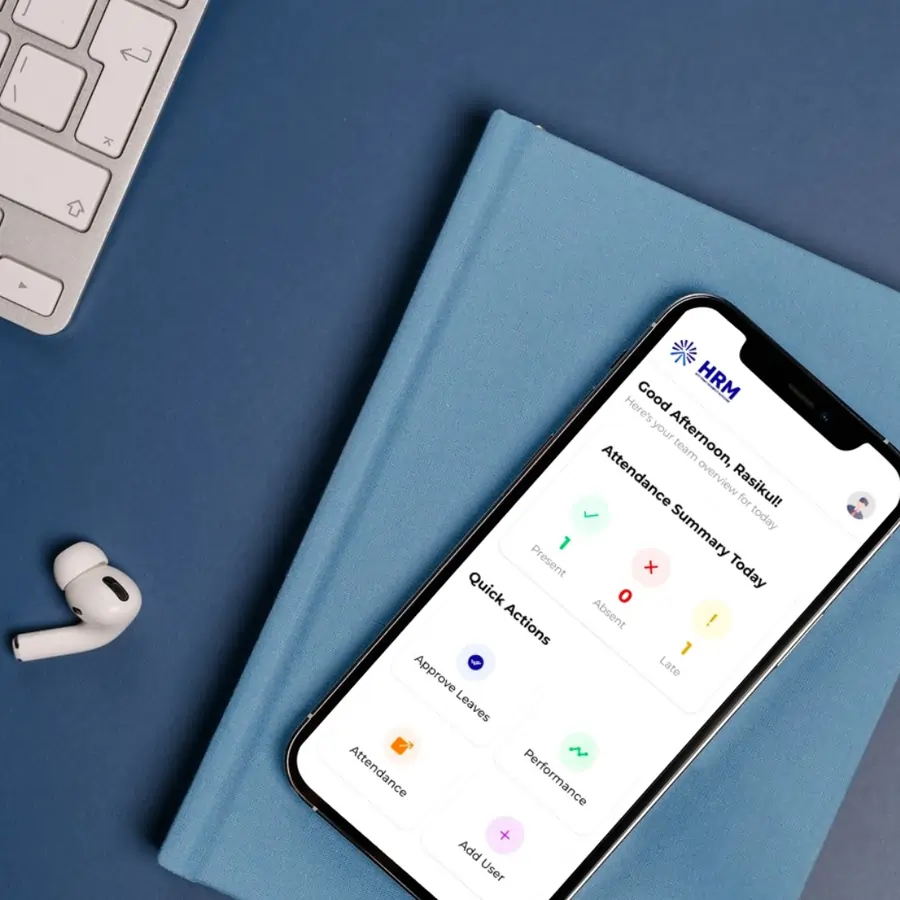
A full-featured mobile HR platform built from scratch — covering employee management, attendance tracking, payroll automation, payslip generation, and role-based access — all delivered as a cross-platform app ready for businesses of any size.
HRM APP
Sector
Enterprise HR, India
Org Size
Large-scale workforce
Timeline
3 weeks to results
Platform
iOS & Android
The Challenge: When
Presence Isn't Productivity
For HR departments in large Indian enterprises, two problems quietly drain operational capacity every day. The first is verification: ensuring that employees who have clocked in are genuinely at work, whether in the office or remotely. The second is coordination: managing the constant flow of leave requests, approvals, and team availability information across departments and locations.
Traditional solutions have consistently fallen short. Swipe-card systems verify entry to a building, not engagement with work. Paper-based leave registers create bottlenecks, delay approvals, and leave employees without a reliable view of who is available. Remote and hybrid work arrangements — increasingly common post-pandemic — exposed further gaps: location spoofing and proxy attendance became persistent concerns that HR teams lacked the tools to address systematically.
HR teams found themselves spending the majority of their working hours on manual coordination — chasing signatures, reconciling attendance sheets, and fielding leave queries — rather than on the strategic, people-centred work that actually grows an organisation.
The Solution: Purpose-Built for Real Operating Conditions
The HRM app was designed from the ground up to address these specific failure points. Rather than layering digital features onto legacy processes, it rethinks the core workflows — attendance, leave, performance, and documentation — as an integrated, verifiable system.
Biometric Attendance Verification
Dual-factor authentication combines hardware biometric scanners in the office with app-based biometric verification for remote workers. Both channels are resistant to gaming — geolocation spoofing and fake check-ins are structurally prevented, not just discouraged by policy.
Centralised Leave Management
A shared leave calendar gives every employee real-time visibility into who is out, when, and why. Teams can plan independently, reducing the back-and-forth that previously consumed HR's time. Approvals flow through a defined digital path, eliminating paper queues entirely.
Automated Performance Reporting
Performance evaluations are generated automatically from a composite of attendance data, leave patterns, and structured input from HR and line managers. Assessments become objective and consistent — grounded in actual data rather than recency bias or subjective recall.
Secure Digital Document Storage
All employee records move from filing cabinets to a secure, searchable digital repository. Audit trails are maintained automatically. Documents are available instantly when needed, without retrieval delays or risk of physical loss.
Implementation: Three Weeks, Measurable Outcomes
The rollout was structured to minimise disruption while building employee familiarity rapidly. Implementation proceeded in overlapping phases, with the HR team supported throughout by onboarding resources and technical assistance.
Week 1
Infrastructure & Onboarding
Biometric scanners integrated at office entry points. App deployed across iOS and Android devices. HR administrators trained on dashboard configuration, leave policy setup, and reporting templates.
Week 2
Live Operation & Calibration
Employees began logging attendance through both office and remote channels. Leave management went fully digital. Initial data from the attendance system fed into the performance reporting module, surfacing baseline insights immediately.
Week 3
Optimisation & Results Measurement
The system operated at full capacity with no manual fallback. HR teams redirected bandwidth from administrative coordination to strategic initiatives. Attendance patterns, leave trends, and productivity indicators were tracked against pre-implementation baselines.
Results: Quantified Impact Within Three Weeks
The outcomes were measured against pre-deployment baselines across three primary indicators. Each reflects a structural change in how work gets done — not a temporary improvement driven by novelty or novelty-of-measurement.
|
Metric
|
Change
|
Operational Significance
|
|
|---|---|---|---|
Why It Worked: Design Aligned to the Problem
The HRM app succeeded not because it introduced new technology, but because it replaced processes that were genuinely broken — and it did so without requiring employees to change behaviour dramatically. Checking in biometrically takes the same time as swiping a card. Submitting leave through an app takes less time than filing a paper form. The friction was removed; the accountability was added.
For HR directors assessing similar solutions, several factors are worth noting. First, the dual-channel attendance model — office hardware plus mobile app biometrics — means the system does not create a two-tier experience for office versus remote workers. Both channels are equally rigorous. Second, the centralised leave calendar solves a coordination problem that most HR systems address inadequately: the gap between approved leave and team-level visibility. Third, automated performance reporting reduces a source of significant management subjectivity and time investment, producing assessments that employees are more likely to perceive as fair.
The three-week timeline to measurable results is particularly relevant for operations managers evaluating ROI timelines. This is not a long-horizon transformation project. The results are structural and appear quickly because the system addresses root-cause inefficiencies rather than symptoms.
Conclusion: HR as a Strategic Function
The persistent challenge for enterprise HR departments is not a shortage of good intentions — it is a shortage of time and reliable information. When the majority of HR bandwidth goes toward administrative coordination, the strategic work that drives retention, culture, and performance improvement does not happen.
The HRM app changes that equation directly. By making attendance verifiable, leave coordination automatic, performance data objective, and records secure and accessible, it returns HR teams to the work they were hired to do. The outcomes documented here — a 1.5× productivity increase, a 40% reduction in absenteeism, and a materially lighter administrative burden — were achieved in three weeks. They represent a new operational baseline, not a temporary improvement.
For organisations still managing attendance on sign-in sheets and leave on shared spreadsheets, the question is not whether a solution like this would deliver value. The question is how much has already been lost waiting to find one.